In the vibrant world of sewing, the ongoing debate about the best pattern type continues to engage sewists of all skill levels. Whether you’re a seasoned expert or just starting your sewing journey, selecting the right pattern can dramatically influence the success of your projects. With a wide array of options available, understanding the benefits and drawbacks of each pattern type is crucial for making an informed decision that aligns with your needs and preferences.
The sewing community is increasingly polarized between Traditional PDF Patterns, Projector PDF Patterns, and Paper Patterns. Each type offers unique advantages and challenges, ranging from cost-effectiveness and convenience to environmental impact and ease of use. By closely examining these factors, you can choose the pattern type that will enhance your sewing experience and help you achieve stellar results in your projects.
In this comprehensive guide, we’ll take a closer look at each pattern type, exploring their distinctive features and providing tips on how to maximize their potential. By the end, you’ll have a clear understanding of which pattern type is ideal for your next sewing project, enabling you to sew with confidence and efficiency.
Traditional PDF Patterns
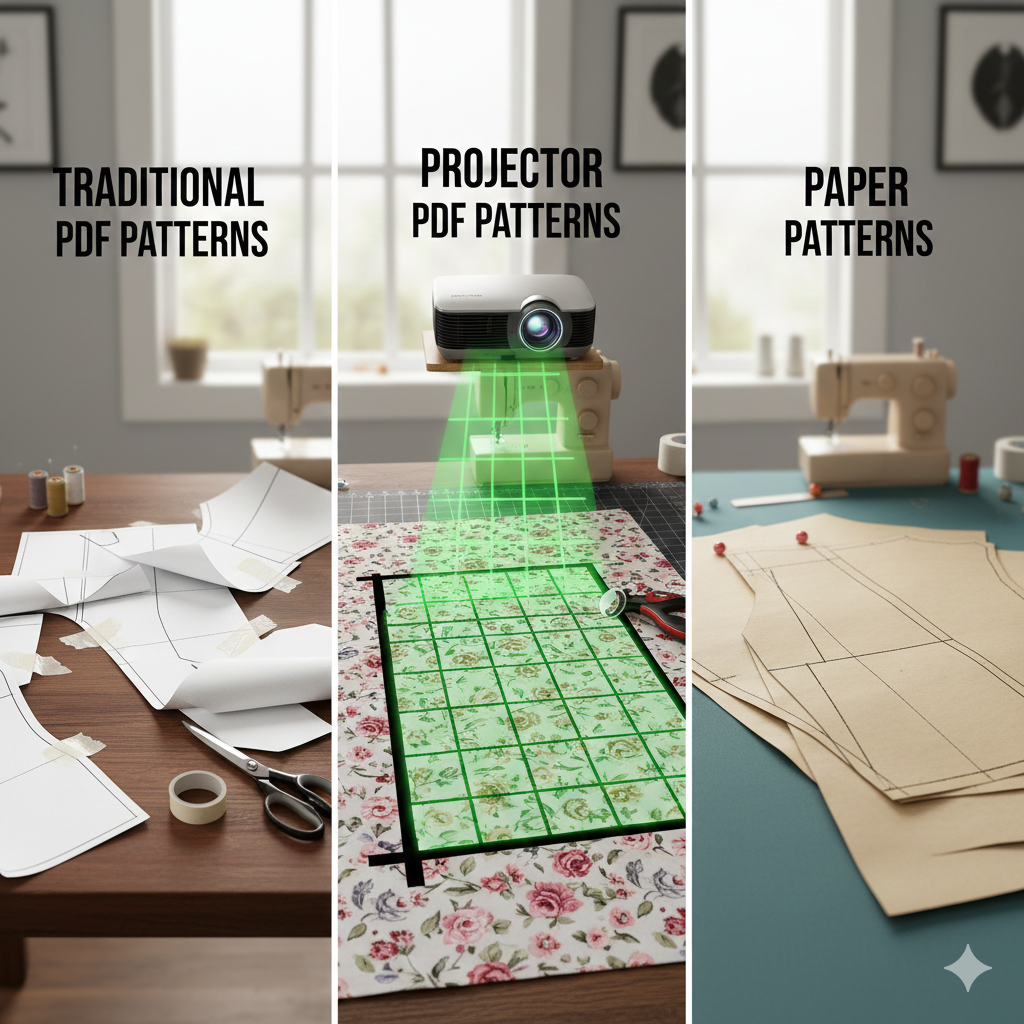
Traditional PDF Patterns have transformed how sewists access and utilize patterns. Instantly downloadable, these patterns can be printed at home on A4/US Letter/A3 paper or at a print shop on larger A0 sheets. This flexibility has made them a favorite among modern sewists who value convenience and cost savings. However, the assembly process, which involves printing multiple pages and taping them together, can be time-consuming and occasionally frustrating.
A4/US Letter/A3 PDF Patterns
Pros:
- Instant Access: Download and print immediately from the comfort of your home.
- Accessibility: Compatible with most home printers.
- Convenience: Print specific sections as needed without wasting paper.
- Cost-Effective: Eliminate the need for professional printing services.
Cons:
- Assembly Required: Printing and taping multiple pages can be time-consuming.
- Paper and Ink Costs: Frequent printing can lead to significant expenses in paper and ink.
- Alignment Issues: Ensuring precise alignment of multiple pages can be challenging.
A0 PDF Patterns
Pros:
- No Assembly Needed: Printed on a single large sheet, eliminating the need for taping.
- Professional Finish: More accurate and easier to handle during cutting.
- Time-Saving: Reduces preparation time, allowing you to start sewing sooner.
- Durable: Can be printed on sturdier paper, enhancing pattern longevity.
Cons:
- Professional Printing Required: Needs to be printed at a print shop with a large-format printer.
- Higher Cost: Large-format printing can be more expensive than home printing.
- Accessibility: Not everyone has easy access to a print shop.
Projector PDF Patterns
Projector PDF Patterns represent a modern, innovative approach to sewing, eliminating the need for paper entirely. By projecting the pattern directly onto your fabric, you can save time and reduce paper waste, making this an eco-friendly option. This method ensures accurate scaling and alignment, provided you have the necessary equipment and technical skills to set up and use a projector. While the initial investment may be higher, many sewists find the long-term benefits and precision well worth the cost.
Pros:
- No Printing Needed: Project patterns directly onto fabric, skipping printing and taping.
- Accurate Scaling: Digital projections ensure precise pattern scaling without printer discrepancies.
- Quick Setup: Once set up, the process can be faster than printing and assembling paper patterns.
- Eco-Friendly: Reduces paper and ink usage, making it an environmentally sustainable option.
Cons:
- Equipment Cost: Requires a projector and potentially other setup tools, which can be a significant upfront investment.
- Technical Skills: Requires some technical know-how to set up and use the projector effectively.
- Space Requirement: Needs a dedicated space where the projector can be mounted or positioned properly.
Paper Patterns
Paper Patterns have withstood the test of time, remaining a favorite among sewists for their ease of use and tactile experience. These ready-to-use patterns come pre-printed and do not require any assembly, making them straightforward for beginners and convenient for those who prefer a hands-on approach. However, they can be more expensive due to printing and shipping costs, and they require physical storage space, which can be a drawback for those with limited room.
Pros:
- Ready to Use: No assembly required; patterns are ready to use straight out of the package.
- Durability: High-quality paper patterns can be reused multiple times if stored properly.
Cons:
- Higher Cost: Typically more expensive due to printing and shipping costs.
- Storage Space: Requires physical storage space and can become bulky if you accumulate many patterns.
- Limited Availability: Must wait for shipping and delivery, which can delay project start times.
- Seam Allowances Not Included: Generally, paper patterns do not include seam allowances.
By understanding the pros and cons of Traditional PDF Patterns, Projector PDF Patterns, and Paper Patterns, you can make an informed choice that aligns with your sewing goals and lifestyle. Whether you prioritize immediate access, environmental sustainability, or the traditional feel of paper patterns, there is a pattern type that will meet your needs and help you bring your creative visions to life.